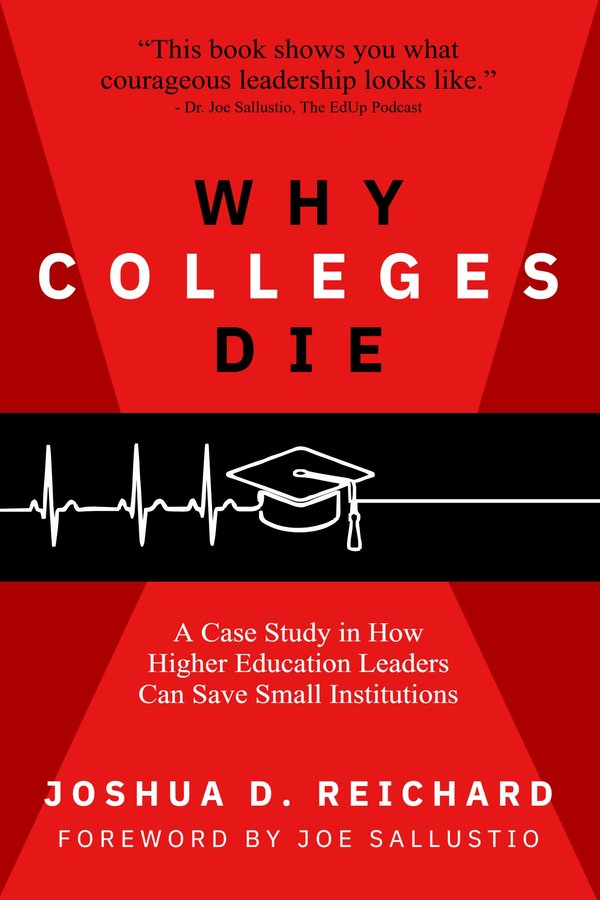
Book cover of Why Colleges Die: A Case Study in How Higher Education Leaders Can Save Small Institutions by Joshua D. Reichard, foreword by Joe Sallustio
“This book shows you what courageous leadership looks like.” Dr. Joe Sallustio, The EdUp Experience

Why Colleges Die

A Case Study in How Higher Education Leaders Can Save Small Institutions

Joshua D. Reichard Foreword by Joe Sallustio

Paperback · Kindle · Free open-access PDF

The Omega Graduate School turnaround

From the edge of closure to a stable footing

From 47 students to
155%
Enrollment growth
From 69% to
98%
Retention rate
From 36% to
99%
Graduation rate
From 24% to
3%
Students on financial hold
From heavy debt to
$0
Debt-free, with a growing endowment

“This turnaround is real, but it is fragile.” The book is explicit about what these numbers prove, what they do not, and which risks a recovery creates.

About the book

Colleges don’t die from one catastrophe

They die slowly, as weak finances, falling enrollment, deferred maintenance, unclear strategy, passive governance, and drift from mission reinforce one another until decline feels normal.

In 2018, Omega Graduate School, a small, faith-based graduate institution founded in 1981, was in an existential crisis. Enrollment had fallen to 47 students. Nearly a quarter of them were on financial hold. The school carried heavy debt, had exhausted its line of credit, and was operating out of a deteriorating campus. Then a pandemic arrived.

Joshua D. Reichard accepted the presidency without pay. Why Colleges Die is his inside account of what came next: selling most of an underused campus to retire the debt, separating governance from management, rebuilding programs around the mission rather than abandoning it, leading a digital transformation, and planning for the day the turnaround team is gone.

Inspired by Hollis L. Green’s classic Why Churches Die, each chapter pairs a recurring cause of institutional decline with a practical leadership response. The book is candid about its limits, separating documented facts from interpretation, and it says plainly that not every college should survive. Deciding whether to renew, merge, or close is part of responsible stewardship too.
The framework

Three mandates. Eight practices.

The mandates organize the story; the practices carry the lessons other leaders can adapt to their own missions, regulations, resources, and students.

Part I · Chapters 1–5

Heal the Wounds

Restore institutional agency: diagnose connected causes honestly, regain financial control, embrace audits, clarify authority between board and administration, and repair relationships so the institution can act rather than merely react.

Part II · Chapters 6–10

Restore the Foundations

Join agency to imagination: identify what must endure, then redesign enrollment, academic programs, technology, institutional identity, and team roles around that purpose.

Part III · Chapters 11–12

Adapt for the Future

Institutionalize the renewal: protect long-term resources and plan for succession so knowledge, authority, and relationships outlast any one leader.

The eight practices

  1. Accurate diagnosis
  2. Disciplined finance
  3. Clear governance
  4. Mission focus
  5. Process simplification
  6. Staged innovation
  7. Organizational health
  8. Strategic succession

Table of contents

Twelve ways colleges die, and what leaders must do

Introduction: Why Colleges Die and How Leaders Can Save Them

Part I · Heal the Wounds

  1. 01Colleges die when decline is normalizedLeaders must diagnose real problems
  2. 02Colleges die when debt constricts choiceLeaders must restore financial flexibility
  3. 03Colleges die when cash runs shortLeaders must align revenue and expenses
  4. 04Colleges die without financial accountabilityLeaders must embrace audits
  5. 05Colleges die when governance delays actionLeaders must drive board reform

Part II · Restore the Foundations

  1. 06Colleges die when enrollment declinesLeaders must propel recruitment and retention
  2. 07Colleges die when degrees do not meet student needsLeaders must revise academic portfolios
  3. 08Colleges die when technology disrupts learningLeaders must prioritize methods over means
  4. 09Colleges die when they lose distinctivenessLeaders must protect institutional identity
  5. 10Colleges die when teams cannot work togetherLeaders must clarify roles

Part III · Adapt for the Future

  1. 11Colleges die when the present consumes the futureLeaders must protect resources
  2. 12Colleges die without continuityLeaders must plan for succession

Conclusion: What Keeps Colleges Alive

From the Foreword

From 2020 to 2026, I have sat across the microphone from more than 500 college and university presidents on The EdUp Experience Podcast. I have heard every version of the turnaround story. Most of them are told from the far side of the finish line, polished, with the hard parts sanded off as talking points.

This is not that book.

Higher education does not need more eulogies. It needs more leaders willing to look at the numbers, tell the truth, and act before the options run out.

Listen · The EdUp Experience · President Series

Why Lean Startup Leadership Is Essential for Higher Education Survival

Dr. Reichard joins Joe Sallustio to talk about how selling underused physical assets, budgeting from zero, and empowering presidents to lead like startup CEOs helped Omega Graduate School eliminate its debt and rebuild enrollment.

Released November 11, 2026

Endorsements

What higher education leaders are saying

In Why Colleges Die, Dr. Joshua Reichard offers a compelling and refreshingly candid examination of what happens when institutions lose their ability to adapt. He clearly addressed what courageous, disciplined leadership can do to change that trajectory. … Why Colleges Die is an important and timely reminder that meaningful transformation begins with leadership willing to challenge what is, in service of what could be.
Dr. Shawntel D. LandryChief Academic Officer, Vocate Education Solutions; Former College President and Provost
In Why Colleges Die, Dr. Joshua Reichard brings these challenges into focus through a candid and thoughtful account of Omega Graduate School’s incredible turnaround. … His framework for healing institutional wounds, restoring foundational strengths, and adapting for the future provides a useful perspective for leaders navigating financial pressures, organizational challenges, and changing expectations. … I highly recommend this book to presidents, trustees, academic leaders, and anyone committed to building institutions that remain relevant, resilient, and sustainable.
Dr. Eric KleinVice Provost for Academic Affairs, American College of Education
Why Colleges Die … is a book written for such a time as this. Dr. Reichard offers a true success story and core, researched principles that other leaders can follow. For the many small colleges facing confusion and challenges, he provides a proven road map. I had a front-row seat to the before and after of the Omega Graduate School turnaround, and this book tells the facts without embellishment.
Dr. Brad SmithChancellor and Former President, Bakke Graduate University

Open access

Read the entire book free

Every small college leader should be able to read this book, whatever their budget. The complete digital edition is permanently free.

Share it with your board, assign it in your course, or use it at your cabinet retreat. It is licensed under Creative Commons Attribution-NonCommercial 4.0, so you may copy, share, and adapt it for non-commercial purposes with appropriate credit. Prefer print? The paperback and Kindle editions are available on Amazon.

CC BY-NC 4.0

Cite this book (APA 7)

Reichard, J. D. (2026). Why colleges die: A case study in how higher education leaders can save small institutions. ACRSS Academic Press. https://whycollegesdie.com/

Book details

  • PublisherACRSS Academic Press
  • Year2026
  • Pages172
  • ISBN (paperback)979-8-9826987-0-4
  • ISBN (eBook)979-8-9826987-1-1
  • Access Open Access
  • LicenseCC BY-NC 4.0
Portrait of Dr. Joshua D. Reichard

About the author

Joshua D. Reichard

PhD, EdS, MBA, CCS

Dr. Joshua D. Reichard is President and CEO of Omega Graduate School and the American Centre for Research in the Social Sciences (ACRSS). He accepted the Omega presidency without compensation in 2018, at what he describes as perhaps the lowest point in the institution’s history, and led the turnaround chronicled in this book.

A Certified Clinical Sociologist, he approaches institutional leadership diagnostically, connecting immediate problems to the organizational structures, histories, and incentives behind them. He holds PhDs from the University of the Western Cape, the University of South Africa, and Omega Graduate School, along with postgraduate credentials in educational leadership, business, data science, and computer science education.

Dr. Reichard also serves as the Director of AI Strategy and Enablement at the American College of Education, where he has served for more than a decade as a course developer, doctoral faculty, and an academic project manager.

Also by the author: Dogmagenic Disorders (SacraSage Press, 2026).

Media & speaking

Book Dr. Reichard

Dr. Reichard is available for podcasts, interviews, conference keynotes, board retreats, and cabinet workshops. Review copies are available to journalists, reviewers, and faculty. Hear him in conversation with Joe Sallustio on The EdUp Experience.

  • Why small colleges close, and the warning signs leaders normalize
  • Leading a turnaround without pay, during a pandemic
  • Selling the campus to save the mission
  • Policy governance: separating the board’s work from management
  • Renew, merge, or close? Stewardship decisions for trustees
  • Succession planning so a turnaround outlasts its leaders

Or email media@whycollegesdie.com

FAQ

Common questions

Is Why Colleges Die really free to read?

Yes. A complete digital edition is permanently available as open access on this site under a Creative Commons Attribution-NonCommercial 4.0 license. Paperback and Kindle editions are available on Amazon for readers who prefer them.

Who is the book written for?

College and university presidents, trustees and regents, cabinet members, academic leaders, and anyone responsible for the future of a small, tuition-dependent institution. It is also suited to graduate courses in higher education leadership and administration.

Is this only relevant to graduate schools or faith-based colleges?

No. The case is a small, faith-based graduate school, and the book is candid about how that limits direct comparison. But the core problems it addresses (recognizing danger, governing under pressure, restoring financial stability, aligning programs with mission and demand, and making improvements last) are shared by small institutions of every type.

Can I use it with my board or in my course?

Yes. Under CC BY-NC 4.0 you may share and adapt the book for non-commercial purposes, including classes, board retreats, and professional development, as long as you credit the author and link to the license. For bulk print orders, use the contact form above.

How does the book relate to Why Churches Die?

The book is dedicated to Hollis L. Green, founder of Omega Graduate School and author of Why Churches Die. Its chapter titles echo Green’s approach by pairing each recurring cause of decline with a practical leadership response.

Act before the options run out

Read it with a pen in your hand, then share it with your board.